I requested Georgette to help me take some photos but had forgotten to switch the camera mode away from Gourmet mode...The results are...interesting:


Session today was on matching height by lowering stance and footwork revision. Felt jabs to be snappier today but have to remember to maintain squared up posture even when working the jab.
 The CMD system strongly emphasizes remaining in the stand-up game for several reasons. In a self defense situation, you don't want to be on the ground as unlike training mats, the ground in the real world is often hard and unforgiving but perhaps more importantly, it leaves you vulnerable to multiple attackers. Take-downs are generally quite committal moves where if it isn't successful, it tends to leave you in a vulnerable position.
That being said, take-downs do remain an essential part of any martial artist's repertoire as executed properly, it can easily put you in a position to get away or gives you options when you are being overwhelmed by a superior stand-up fighter. Learning to execute a proper take-down also ensures that your partner gets proper training in learning take-down defenses.
Yesterday we focused on the double leg take-down. These are my notes from yesterday's session:
- As a general rule, don't just directly go for a take-down, set it up with strikes to the head to distract before going in for the take-down.
- Make sure you're close enough to do it, and you should be at rim-shot range.
- After striking, level change first by dropping your body to a lower level and bending the knees, then shoot in by driving your lead foot between the gap in his legs.
- Using cupped hands, aim for the back of the thighs above the knees and lift and pull.
- Lift with your legs (not your back). Back must be kept straight and not stooped forward to make sure that you are not lifting with your back which is more difficult and can result in injury.
- Head is placed on the side of his body, below the armpit area and is in the opposite side of the leg that stepped through.
- As you lift, start turning over his legs in the direction that your lead leg is in while using your head to also push into his body to help the take-down along. You want to imagine lifting and then rotating him in one smooth movement as if you're picking up a oil drum full of water and dumping the water to the side.
- The rotation is important to sweep him completely off-balance and ensure that when he lands, he cannot get you into guard.
- Remain balanced while doing this and aim to remain standing after the take-down (though if you can get into side-control to move into mount is also good)
- When in a mirrored stance, it may be easier to take a step in with the back leg as it allows you to scoop up and lift your partner's already bent front leg.
- If your opponent is significantly shorter than you, it might be difficult to go for this take-down due to the extreme level change you would have to do which sacrifices your balance.
While doing some background reading, I realized that recently the International Judo Federation had banned this technique (morote-gari), most likely due to traditionalists viewing the technique as 'bad judo'. I don't understand why such an effective technique should be banned though Bill Lewis had suggested that it was because it was easy enough for amateurs to do and is not exciting enough for spectators.
Conversely, I think this is the very one reason why this technique has to be studied. Out there, someone may just try to take you down with a similar tackle or a sloppy double leg. Knowing a take-down's mechanics and knowing that you can defend against a proper take-down gives us the necessary tools and mental readiness to deal with it.
Rodney's recent move towards implementing take-down defenses in the Evolutionary Core of his system probably reflects this thinking.
Credits: Picture taken from EHow.
With CMD it's about protecting the head....with these guys....
Although Crazy Monkey Defense (CMD) was designed for a self preservation martial art rather than for MMA ring fighting, it has seen its use in competitive fighting.
Costa Ioannou one of Rodney King's students and a CMD trainer, successfully used CMD in the EFC in his first ever pro fight. The photos show classic CMD in action! Costa is in the white and blue trunks.
Images taken from EFC Africa.


We have progressed further into the Evolution Core of CM with the incorporation of more clinch work and takedowns.
My arms have been aching from all this work but it's a nice sort of burn and gives me the feeling that I've got a good workout!
CM's hunchback stance and its squared hip reasoning is reinforced when takedowns are incorporated in. Because of the squared hip, we can readily go into a sprawl position which is very difficult to do from a side facing/blade stance.
Here's a video of our first exposure to the sprawl:
And here's a video of the beginning of integration between all elements of the CM E-Core game, takedowns, clinch and boxing. In these sparring videos, we were focusing more on entering into clinch and takedowns hence the reduced boxing. Knees have not been incorporated yet as well.
Our first session:
Notes from the sparring:
- Be aware of closing off the center line. Do not lose attention.
- Remember to get full extension on punches even when moving forward. Switch to 3PC if intending to clinch.
- Position hands so they don't get locked up in clinch.
- The takedown attempt was not a good idea and left me open to knees nor did it have the necessary driving force to reach. Need to make sure my upper body is more upright if I'm attempting takedown. Especially not a good idea when his hands were already on my head.
Notes from this sparring session:
- A more raised back heel and don't narrow stance too much.
- Better use of 3 point Cover.
- Smoother entry into a necktie
- More fluid combinations.
- Better control of speed and pace.
- Try not to charge in like a freight train.
Perhaps the most important thing to be taken from this session after consulting with the helpful guys at the CM Pro Gym (thanks guys!), is to be more proactive with the jab even though you might not land.
Chris Bishop:
JAB!!!!! Use your jab to gauge distance. Use your jab to stop them coming forward... he is able to walk in on you because there is nothing holding him back... stiff jab to the face will make his job harder. Secondly when you work your jab, you will then be able to follow with combinations. You both seem to have an 'all or nothing' mentality with the punching, as in if you can't hit the person you don't throw.... the jab is like a blind man's cane, constantly probing to find objects, feeling around and giving feedback to the blind man. It doesn't touch something all the time, but it's looking.
Scott Walker:
Spend some time on getting that jab really working for you and then start to let the cross work its when in naturally. Get your distancing down and control the range with jabs and crosses and get it to happen automatic. In other words, put some time into getting those straight punches to come off with out having to plan it out, such as "I am now going to jab and cross".
...
Long story short learning to throw a jab that lands a a few inches from their face as I worked my way in and instead finding my range on the second or third jab really helped me. This of course is not done every time because you would become predictable, but I learned a lot from it.
...
playing the single shooter jab a lot more and really working on being creative with the jab and coming in on all different angles was a lot of help too.

A proper hook is actually a close-ranged punch. Its power comes from the from the heel and the twisting motion of the hip. It's a very devastating punch but it requires a lot of positioning to pull off properly.
A lead hook is easier to pull off as it's not as easy to read and the distance to the target is shorter.
A good way to enter into a hook is to slip to the outside while he punches and land a hook. Being a southpaw, it's easier for me to slip to the outside of his jab to hook. Instead of slipping, you can also jab while entering while prepping for a hook.
An uppercut is different in that you have to lower your weight first and then spring up from your hips to deliver a punch, ideally to the chin. The hand is also kept tight. Due to the way the hand drops down and the angle of the punch, a rear uppercut is easier to do then a lead uppercut. It took requires the closing of distance and it is ideal to open up with jabs, crosses before attempting an uppercut.
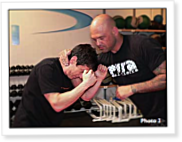
Here's to record some of the things we've worked on.
The Entry: Coming close in with your hand guards connecting almost dead on to each other. To get into this distance, use CM2.
The Half Necktie: Snake one of your hand in between his guard around his neck and with your hands cupped onto the crown of his head. Your forearm should be in contact with his neck. Maintaining the necktie requires you to drive forward pressure from the elbow area into the neck rather than trying to to force him down with your arm.
This should be utilized with strikes to the face which can be simple punches, hooks or even uppercuts.
Completing the Necktie: While retaining firm control of your half necktie, only then attempt to snake in the other hand. It is ideal to still go inside the guard but in practice may be difficult so sometimes it's ok to go outside the guard. As long as you have either hand inside, you can establish a solid grip. Do the same thing as the first necktie except place your remaining hand on top of the hand of the first necktie. Rest your chin on your hands and make sure to focus on squeezing your elbows together. Shoulders should be relaxed.
Upon establishing a successful complete necktie, then you can proceed to knee him.
In practice it's sometimes possible to surprise someone with both hands outside his guard and then snake one in but it was not so reliable especially if the other guy knew what he was diong.
An interesting thing I learnt from watching Randy Couture is how he used the half necktie. As the person tries to square up to get out of the necktie, you pull him a bit toward you and then switch to the other side to get the opposite necktie. Playing around with it, it was quite effective but it remains important to continue to be trying to punch the head.
Another tactic I found particularly effective is to CM2 and then ram the person with my guard. As he is pushed back I throw punches forward.

