It was Lawrence, Foong and Alex's first class on clinch so we went back to basics. This revisit was a moment of 'eureka' for me.

I had been having problems understanding on how to bring the head down easily. Although I knew that you had to drive in the elbow to the neck and cup the hand on the crown of the neck, I still found it required quite a bit of effort to break the posture. I had previously dismissed this as a problem in timing of lack of practice.
What I was apparently missing was the visualization of the elbow as the fulcrum of the lever. Although I was driving in the elbow, I wasn't using it as a pivot point for the clinch. I had been pushing with my elbow and trying to pull down with my hands. Imagining it as a single lever immediately made the clinch very easy.


This actually reminds me of a movement in Aikido where the hands are held from behind. Should you try to bring it forward directly this is difficult but if you focus on bending your elbows first to draw the uke in, you can easily bring your hands in front of you.
It is amazing how strong biceps can be with a properly grounded fulcrum!
Albert also went through the defenses against the clinch.
The first is a preventive measure where you want to turtle up your neck to make it more difficult for your head to bring down which also protects the sides of your neck. It was much harder to establish a solid clinch when the neck is turtled since you don't have a solid location to ground your elbows/upper forearm.

Two other defenses were shown in the case where the clinch is already partially in. The 'shrug' is a popping motion that you use before your opponent gets a solid grip in and also the 'corkscrew punch' where you place the your vertical fist on your opponent's face and corkscrew in in a twisting motion to shove his face away and break his posture and clinch. The corkscrew punch is used when the elbow is already firmly lodged on your neck making shrugging difficult.

Alex raised a good point where because of my height and long limbs, he was having problems breaking my clinch even when he had fully extended his corkscrew punch. Albert told him that it wasn't something to be overly concerned about as first, my face would have already been punched and secondly my front body would be completely exposed to body-shots so it would be pretty hard for me to complete a full clinch.

Class ended with some light sparring with a focus on entering into clinch and fighting for the dominant position (both hands inside). Foong did an awesome job fighting for the dominant position with me and we frequently ended up in a neutral position.

And Lawrence helping me to take off my gloves. :D Special thanks to Georgette who stuck around through the whole class to take photos for us!

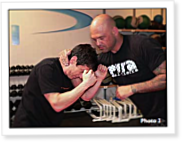
Here's to record some of the things we've worked on.
The Entry: Coming close in with your hand guards connecting almost dead on to each other. To get into this distance, use CM2.
The Half Necktie: Snake one of your hand in between his guard around his neck and with your hands cupped onto the crown of his head. Your forearm should be in contact with his neck. Maintaining the necktie requires you to drive forward pressure from the elbow area into the neck rather than trying to to force him down with your arm.
This should be utilized with strikes to the face which can be simple punches, hooks or even uppercuts.
Completing the Necktie: While retaining firm control of your half necktie, only then attempt to snake in the other hand. It is ideal to still go inside the guard but in practice may be difficult so sometimes it's ok to go outside the guard. As long as you have either hand inside, you can establish a solid grip. Do the same thing as the first necktie except place your remaining hand on top of the hand of the first necktie. Rest your chin on your hands and make sure to focus on squeezing your elbows together. Shoulders should be relaxed.
Upon establishing a successful complete necktie, then you can proceed to knee him.
In practice it's sometimes possible to surprise someone with both hands outside his guard and then snake one in but it was not so reliable especially if the other guy knew what he was diong.
An interesting thing I learnt from watching Randy Couture is how he used the half necktie. As the person tries to square up to get out of the necktie, you pull him a bit toward you and then switch to the other side to get the opposite necktie. Playing around with it, it was quite effective but it remains important to continue to be trying to punch the head.
Another tactic I found particularly effective is to CM2 and then ram the person with my guard. As he is pushed back I throw punches forward.

