 When I first learnt about hooks, I thought it was about any punch that looped around in an outside arc. The kind of punches you see in bar brawls and untrained fighters.
A proper hook is actually a close-ranged punch. Its power comes from the from the heel and the twisting motion of the hip. It's a very devastating punch but it requires a lot of positioning to pull off properly.
A lead hook is easier to pull off as it's not as easy to read and the distance to the target is shorter.
A good way to enter into a hook is to slip to the outside while he punches and land a hook. Being a southpaw, it's easier for me to slip to the outside of his jab to hook. Instead of slipping, you can also jab while entering while prepping for a hook.
An uppercut is different in that you have to lower your weight first and then spring up from your hips to deliver a punch, ideally to the chin. The hand is also kept tight. Due to the way the hand drops down and the angle of the punch, a rear uppercut is easier to do then a lead uppercut. It took requires the closing of distance and it is ideal to open up with jabs, crosses before attempting an uppercut.
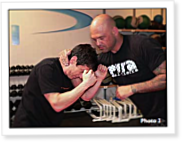 Clinching
Here's to record some of the things we've worked on.
The Entry: Coming close in with your hand guards connecting almost dead on to each other. To get into this distance, use CM2.
The Half Necktie: Snake one of your hand in between his guard around his neck and with your hands cupped onto the crown of his head. Your forearm should be in contact with his neck. Maintaining the necktie requires you to drive forward pressure from the elbow area into the neck rather than trying to to force him down with your arm.
This should be utilized with strikes to the face which can be simple punches, hooks or even uppercuts.
Completing the Necktie: While retaining firm control of your half necktie, only then attempt to snake in the other hand. It is ideal to still go inside the guard but in practice may be difficult so sometimes it's ok to go outside the guard. As long as you have either hand inside, you can establish a solid grip. Do the same thing as the first necktie except place your remaining hand on top of the hand of the first necktie. Rest your chin on your hands and make sure to focus on squeezing your elbows together. Shoulders should be relaxed.
Upon establishing a successful complete necktie, then you can proceed to knee him.
In practice it's sometimes possible to surprise someone with both hands outside his guard and then snake one in but it was not so reliable especially if the other guy knew what he was diong.
An interesting thing I learnt from watching Randy Couture is how he used the half necktie. As the person tries to square up to get out of the necktie, you pull him a bit toward you and then switch to the other side to get the opposite necktie. Playing around with it, it was quite effective but it remains important to continue to be trying to punch the head.
Another tactic I found particularly effective is to CM2 and then ram the person with my guard. As he is pushed back I throw punches forward.
 Some light sparring
 Serina showing girl power
 When Serina boxes, it looks like she's dancing
 Sparring for tips as we didn't have money to try the new cinema :P
 Bobbing and weaving
Yesterday, we dealt with palming and cuffing punches with the jab/lead hand (not sure if I got the terminology right here).
This works best when having 'matched leads' meaning if my right foot is forward, then the other person is having his left foot forward or vice versa due to
- the shorter distance covered when doing the counter punch which makes it a lot quicker and less telegraphed
- still being protected against the cross with the free hand.
Cuffing happens in the CM1 (rimshot) range and as your partner jabs, you intercept the punch by palming over it with your jab hand and pushing it down and slightly towards you. This redirects the force of his punch and opens his face to a quick flick punch back to his face.
If you are fighting with the same stance, for e.g. orthodox vs orthodox or southpaw vs southpaw, this is a lot more difficult to do.
Parrying can be done with the rear hand which is actually a commonly used technique in traditional boxing. Some notes from an old boxing magazine I found on Google Books which deals with the above situations:
Note: Albert mentions that this isn't directly applicable to CMD due to the different stance and how traditional boxing is less strict about head protection and the hands are not locked to the head but is interesting nevertheless:
Rear-hand parry (assuming orthodox stance):There are several things to note when doing this move
Use the right hand to deflect the jab while the left leg is forward. This is a very fast counter and is one of the most common techniques taught by trainers. Although the parry appears to be a simple movement, mastering it requires speed, timing and accuracy. In order to parry effectively and consistently, the technique must be a short and economical movement. Overextension sets up the fighter for a double jab or a fake. When parrying, remember to keep your rear hand high, relaxed and ready to respond. Once you have parried the jab, return the rear hand to its ready position.
Front-hand parry
The front hand can also be used to deflect a jab but it is generally not encouraged because it removes your lead hand from a protecting position in front of your face. Unless you are highly skilled, there is a tendency to overextend the parry, which creates an opening for your opponent's right cross.
The front-hand parry puts you in a vulnerable position. Nevertheless it is effective against kicks, since you are out of hand range and have more time to react to your opponent's follow-up technique.
- If you're slow or mess up the timing, you could eat one in the face so it is a risk. Remember that your hands leave your face while you are trying to intercept the punch so if he contacts at the wrong time,
- Don't do it too often as if the opponent knows it's coming he can fake you out and then follow in with a real punch.
- Seems to work better if the punch is deflected before it's fully extended as the punch then is relaxed while its still gaining speed. If it's fully extended, you've probably already eaten it.
- There should be very little delay from the parry to the counter punch as you only have a very brief window to execute the counter-punch before he pulls back. Ed: Albert mentions that the counter is not necessarily immediate as sometimes your punching hand can be dragged back towards his face which can be followed with a counter to prevent him from trapping your hand again but this is more a case when using big gloves.
Personally I found the movement a bit awkward as I am used to cutting down with an extended arm like Aikido and doing so with just the lower arm felt tiring and unnatural (for now at least). Definitely one move to actively train while sparring.
Is it me or are CMD classes zooming faster and faster by as my cardio goes up? :(
Since my last post on CMD we have covered quite a lot of material:
- Bobs and slips
- Level Changing and Body Shots
- Feints and false attacks
- Lowering your guard to just above eye level
- Forming a proper fist
- Faking your range
Bobs and Slips
 Moving your body and head so that it's more difficult for someone to punch you. Easier said than done as it has to be random, properly timed, have a quick recovery and yet stay balanced.
With newer students, it was really effective with their slower strikes, but once training with the more experienced peeps, the speed had to increase a lot and more particularly the randomness. Slight CM movement also has to be maintained while doing this as it's too easy while trying to dodge that you forget to CM and take one in the face.
The movement can be slight and in fact the closer it is, the more efficient it is. I find that if you bob or slip too much, it's hard to react quickly with your own counter punch but a slight slip as it maintains your posture generates a much quicker response.
One mistake that I keep on making is that my bob and slip tends to resemble an infinity symbol instead of rapid quick linear movements that are more unpredictable.
Also important not to lean your head in too much as although this is quite effective in avoiding punches...it's not so good if someone decides to grab your head and smash it on his knee...
Level Changing and Body Shots
 Not attacking or defending at one level but constantly moving up and down in an unpredictable fashion. Similar principles to bobs and slips. You can't start too low or else you won't be able to level change.
Important in defending against body shots and side attacks and also keeping yourself difficult to hit.
You lose mobility while dropping low so this is something to consider when deciding to 'shell up'. In one instance I recognized this first hand when I was a bit fearful of body shots and ended up being unable to get away from the barrage although I had my center defended.
For a body shot, in most cases it's good to follow combination theory where you start with a jab to the head first, go for the body shot and then jab as you come out. Trying for a bodyshot straight away in most cases isn't a good idea as it tends to be slower as you have to level change and then punch and if you didn't prep it up, can result in just being hit in the face before you can throw your body shot. More effective against people taller than you since you can drop easier than them though I notice Owen's body shots on me are more effective than vice versa. Something to look into.
Feints and False Attacks
This is where you fake or feint an attack to illicit a response or disrupt the timing of the opponent.
There are several kinds where you punch halfway, pause for a short while then follow through or you can change the direction of your punch halfway for eg from high to low and vice versa. The power on this is pretty weak and is more as an annoyance tactic
It's important not to pull back your punch halfway as it just means more time that you're exposed while you're false attacking and since it's just an annoyance tactic it's not important to generate power from this.
I still preferred the shoulder movement feints coupled with a very quick small dart of the hand that gave the illusion of a punch which was then followed up by an cross or a quick jab. This is especially effective if the opponent's CM is a bit slow or he was not keeping his hands moving as by making him misjudge your timing, there is usually a small hole in his defense that you can punch your hand through.
Lowering your guard to just above eye level
Owen and I have been encouraged to lower our guard to just above the eye level. It sacrifices a bit of head protection for better vision and body protection. It also gives much better hook protection as it's a one size fits all defense for punches towards the head.
Still not totally comfortable with this as you feel suddenly quite naked. The first CM stance we learnt really felt like a womb of sorts where you could hide whenever you were trouble and having that taken away reintroduced my flinching which had gone away previously. Just something that needs to be worked on again!
Forming a Proper Fist
 I often tried to form a fist by clenching it until there was no air in it. What happened was that I also folded up my little fingers in resulting in my index finger taking the brunt of most of the punches. What should be done is for the fist to be squared up so that impact is distributed around the whole of the fist rather than just one or two fingers.
The alignment of the wrist is also important to ensure that upon contact, the energy travels along your hand rather than it resulting in a wrist injury. This can be done by using your hand to point forward and then that's the proper alignment of the wrist. Straight and centered.
At this point in time while using the gloves, I worry about building a bad habit in not learning how to form a proper fist so I try to practice doing it during my idle moments e.g. while waiting for my coffee or bath water in forming the fist as I punch. Would probably prove useful once we move to the MMA gloves.
Faking your range
I often tried to get as much range as possible on my punches and although this is generally a good thing, Albert brought up that this sometimes gave your opponent a very good idea of what your range is especially if you throw out a lot of jabs.
So instead, when throwing range finding jabs, it's sometimes good to not extend fully. That way you continue to occupy some space but give your opponent an underestimation of your range. In practice I found this was pretty effective where although we were told during the class to try it, some of my sparring partners fell for it by rushing forward only to be met with a quick jab before they could throw theirs. I suppose it's also more effective where you have a range advantage.
Basically I expressed how I felt like an outsider with nobody returning my smiles and the instructor more concerned with the other Japanese student whom I was partnered with even when at times I was struggling with the technique as much as the that Japanese student. Even the locker room situation before and after the class was just as tense with nobody talking to each other. Training itself was like some sort of strange religion where the instructor did and you followed without much more than a few words (which I unfortunately did not understand either).
I basically wanted to know if this was an isolated case or was this truly the 'Hombu experience'.
I was told by a few forumers that I had to 'learn humility' and 'be grateful that they let you train there' and that 'training is serious, not to make friends'. In short, they are doing me a favor by letting me be there in the first place and I should be thankful for whatever I got.
To hear this from fellow Aikidoka, really made me wonder how brainwashed are these people? There's one thing to be strict and no nonsense, but another to be unapproachable and expect blind obedience. I doubt having such a 'strict' environment improves learning at all! It's one thing preventing people messing around in class and goofing off, but to have everyone fearful and not daring to talk above a tiny whisper when you are genuinely discussing what works and what doesn't, is to me a very antiquated way of learning.
I think the era where teachers are respected as mini deities is over. A teacher-student relationship is based on communication and understanding, not a hierarchy. Sure, a teacher has to be accorded some degree of respect, but not to the point where the teacher is considered to be a different class of person to you and everything he says is law. A martial art need not be a puzzle that you have to figure out yourself through training thousands of hours if it can be communicated within a few minutes.
In retrospect at my years of training, I wished I had been given some very basic anecdotes that could have been told to me in two minutes, but because no one told me, it took me some 14 years to realize it. That to me is unnecessary and a complete waste of time. Whatever benefit/satisfaction I got from discovering this myself was offset by the sheer amount of time I had invested to find this out.
I guess I can understand this as many martial arts develop in such a repressed environment where your teacher is literally your 'master' and you had to clean his house, do his chores and if he felt like it, he would impart a few techniques to you. But it is still shocking to think that there are those who still believe this is an acceptable and in fact ideal way to learn things.
I cross train Aikikai Aikido with CMD.
Yes I can sense the smirks already :P
Yes, yes, Aikido, that art that has some of the most fake-looking techniques and often steeped in unnecessary mysticism. It's the very essence of a traditional martial art where you watch and then you learn. You deal with single attacks, and seldom any form of combos...you have unrealistic attack scenes, but yet I continue to still practice it.
Why?
Partly because I've been doing it for so long...some 16 years perhaps and also an idealism that effective martial arts can be graceful and non brutal.
However lately, after about 6 months into my training in CMD, I have found that certain aspects of CMD has entered into my Aikido techniques and approach to the art which have unlocked insights that I would have probably not obtained in a traditional Aikido atmosphere.
Perception of an Attack
In Aikido, most students aren't really good attackers. In fact, I think in most Aikido schools, we're trained to be sloppy to let the other person learn the technique. Unfortunately even at the dan levels, due to repeated 'training' of sloppy attacks, we never quite learnt how to do a proper attack, getting further away from practicality.
However, CMD removed my fear of being punched. I no longer flinch and got used to the faster punch speeds. Hence when I trained Aikido, suddenly all the attacks were moving in slow motion and it became incredibly easy to dodge these with increasing efficiency.
You can't expect to apply Aikido to every attack
When I swapped these sloppy attacks with more realistic quick punches, you realized that there are punches that you can't do a technique on (for example a crisp jab), while others which give u a window of opportunity to do something (for example hooks and crosses).
For those jabs, it was basically learning to keep a distance and circle (much like CMD) while deflecting them with non committal slaps. CMD talks about occupying the space with jabs, while Aikido has it all out there ALREADY occupying this space putting you in an ideal position to redirect non committal attacks without sacrificing defense.
Realistic Sparring changes your Mindset- you can't be passive
CMD also introduced me to realistic sparring where you don't really know how the other guy is going to attack. Aikido randoori or jiyuwaza isn't really 'free' in that there are still predetermined attacks and geez they still sometimes attack you with holds...
It's one mindset doing jiyuwaza and another where there is a real danger of being punched and where it's accepted to get punched.
When approaching jiyuwaza with this mindset, you actually develop a more pro-active style, moving in before the person has fully gotten up and pre-emptively striking right before he strikes if his posture is weak.
It no longer is an elaborate dance but resembles a real fight scenario where you're really thinking about how to protect yourself. I think this is what many higher dan Aikido masters have found when they mentioned that in a real life situation you need to take a lot more initiative rather than waiting for an attack to come to you.
In fact you unlock true 'jiyu' where you remove the rules of what's acceptable dojo sparring and are free to innovate.
Atemi is super important
Atemi is the act of striking your opponent. Now are often told that atemi is a distracting move and there are even some Senseis who see atemi as sort of a cheating move.
I don't see it that way but as a necessary extension of what Aikido is. In fact, I believe Morihei Ueshiba advocated the importance of this. In real life, your opponent is not going to be compliant or stationary and you need a surprise jolt to buy yourself enough time to get into position for a technique.
Training counter-punching in CMD is VERY relevant to the proper application of atemi. The timing and applying the necessary force to disorient your uke is an aspect not trained.
Too often in regular Aikido training, atemi is an afterthought, done poorly and more of just a movement that in the heat of a real fight, it's often forgotten or done ineffectively.
A proper atemi hurts. Imagine getting your face smacked by a fist or being punched below the ribs, and most people will be to disoriented to resist your technique.
Some techniques remain a mystery to me
Still some Aikido techniques continue to be a mystery to me and seem only applicable against a crazy guy charging at you giving you full committal. For example, certain versions of kokyu-ho seem incredibly unrealistic unless the guy continued to hold your hand throughout the movement. This is obviously ridiculous in a real life situation.
However I do see a point in learning these techniques as it does teach you the proper flow and extension needed to execute throws but this should be made clear from the beginning rather than passed off as a 'technique'.
A technique that can only be applied on a compliant uke, is not a real technique to me. It's a practice drill.
Aikido against a trained fighter
Now I have to admit, Aikido against a trained fighter will probably have very limited usage. An experienced fighter who just does a little research on Aikido can easily see what an Aikidoka is trying to do and easily prevent it.
Aikido does rely heavily on the element of surprise. In fact I'll be quite confident if I had to spar with someone who only knew Aikido.
Aikido has no place in the octagon/professional fighting as much as BJJ has no place outside 1 on 1 fighting.
However, the majority of the guys you are going to face are untrained fighters or people who aren't actually expecting you to resist in such a manner. This is really in most cases a true self defense scenario where you're going to be caught by surprise and the attacker isn't expecting you to fight back.
Just imagine getting yourself into a CMD stance when faced with attackers, it immediately puts them on notice that you know how to fight and they react accordingly.
The great thing about Aikido is that you can still assume a non threatening stance and yet be ready to explode into action. It builds muscle reflexes where if someone grabs me, I immediately instinctively move into a throw (yes I once threw my ex-gf and almost threw my Japanese tour operator). It is also very final and yet non lethal. Sure a punch in CMD should end most fights but a proper pin or throw has a certain finality to it perhaps only less as compared to a BJJ choke.
Aikido is still relevant
So in my opinion, Aikido is still very relevant. Sure it may not be as 'complete' as CMD, but its applications in a self defense situation are still very real as long as a more realistic emphasis is placed on training.
We often forget that legends such as Morihei Ueshiba and Gozo Shioda perfected their art through real life fighting gaining the necessary instincts to be able to pull off Aikido. In a way, realistic sparring may be that missing element to complete Aikido.
I hope that my journey through CMD continues to open such insights into Aikido and removing the stigma of Aikido as a 'fake' martial art.

